I could go on an on about why I love Rio, but I'll leave it to my friend and travel guru
Ricardo Freire, a.k.a. Riq, author of several travel books and blogs, to explain that oh-so-unexplainable allure that no other city in the world can beat. His text, below, is a beautiful love letter to Rio:

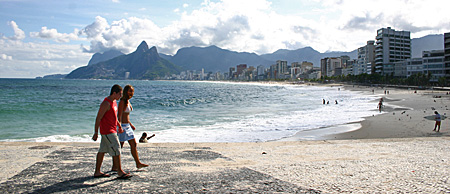
- A boardwalk takes you from Arpoador to Ipanema and Leblon
If you ever ask me why I travel, I’m probably going to answer “In order to see if I can find any place more enchanting than Rio”.
So far I haven’t. Other towns may be superior in one way or another, but get low grades in so many items – such as Bahianas’ wing, enthusiasm and headpieces [items judged in carnival parades] – that on average Rio wins by far.
If you insist on international standards of judgement, OK, here we go: Rio gets Oscars for scenery, art direction, casting, (lack of) costumes, screenplay and original soundtrack. Where else on this planet can you find perfect beaches, a great cultural scene, world-class gastronomy, ample shopping opportunities and an exotic people, everything packed in a single place, yours to enjoy anytime of the year?

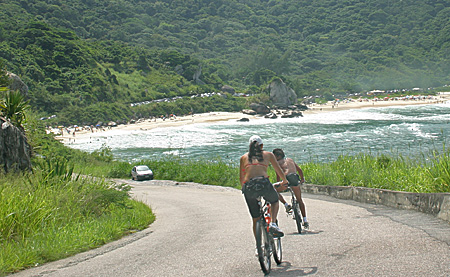
- Prainha, still pristine in the outskirsts of town
To begin with – and I love to say this, because I manage to infuriate at once both Paulistas and Cariocas – Rio is the best thing about São Paulo.
The very Ponte Aérea [the Air Shuttle between São Paulo and Rio, the first of its kind in the world, dating from the 60's] is a fabulous idea – an invention made in Brazil, mind you, product of the alliance between Capital and the desire to flee Labor. The entire flight is gorgeous. Provided the weather is good, you’ll get 30 uninterrupted minutes of coastline being drawn right under your nose: Ilhabela island, Ilha Grande bay, Marambaia cape. Landing is even prettier. The plane dives dangerously toward an airfield that lies beside a Lilliputian Manhattan-like skyline – but as soon as you find yourself out of the plane, the vision of Sugar Loaf mountain at the left corner of the frame eliminates any doubt and welcomes you to Rio de Janeiro.

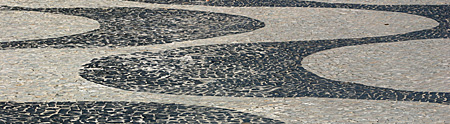
- Sidewalk waves: From Lisbon to Copacabana
After being intensely fought over by three different women who tease you with the same provoking words (“Taxi, Sir? Taxi?), you get on an old Chevrolet cab and glide along the 1950’s lawns of Aterro – the old money of Flamengo beachfront buildings contemplating you from the right hand side, the Sugar Loaf getting closer and closer on your left hand side, and the complete works reminding you that this country has already had cooler aesthetic aspirations.
A little bit later you’ll cross the tunnel and get to Copacabana – the country’s lost ID, the broken mirror of our soul (I give up. No definition I may come up with will be sharper than “Purgatory of beauty and chaos” © Fausto Fawcett).
If Brazil decided to undertake an orthomolecular treatment and had to cut a single hair for sample, this hair (originally curled, then chemically turned straight) would be Copacabana.
We are all there: broke millionaires and emerging favela-dwellers, big land owners and homeless children, retired elders and office boys, upper middle class, lower middle class, fatter middle class, thinner middle class, people of every SPF and from a plethora of genders sharing an one-bedroom neighbourhood complete with six life-saving posts. Copacabana doesn’t live: Copacabana exposes herself. Being able to walk barefoot in Speedos by Nossa Senhora de Copacabana avenue at rush hour reveals more about our civilization than five years studying Social Sciences at the local U.

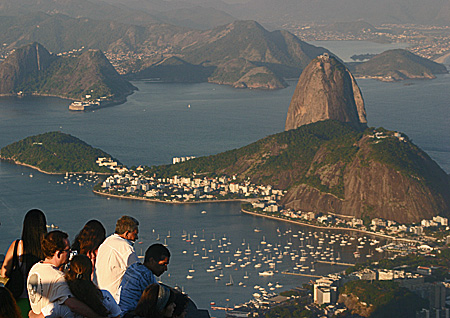
- A tale of two postcards: the view from the foot of Christ the Redeemer statue
I love it but – no, thank you. I’d rather watch Copacabana from a safe distance – at Ipanema or Leblon. It’s prettier; you can go to Plataforma steakhouse invoking the late Jobim (when the truth is you’re going because of the after-beach air-con); and you can always answer “Pela Lagoa” (”By the way of the Lagoon”), no matter what the taxi driver asks.

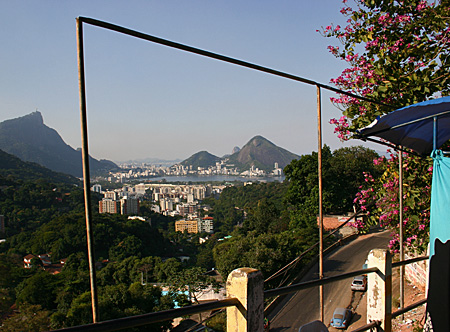
- The Lagoon, perfectly framed at Rocinha favela
Farther than that you may only go (and come back as soon as possible) to the Reserva or Prainha beaches; to Quinta, Bira’s or Tia Palmira’s restaurants; or exceptionally to a concert at Citibank Hall.

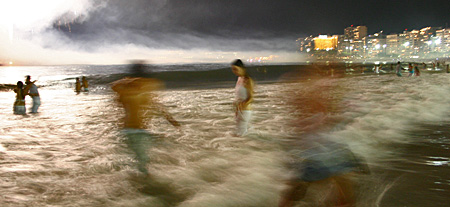
- At Copacabana
In other words: skip Barra da Tijuca. So far Barra doesn’t regard out-of-towners as you and me. Living at Barra seems to be some sort of space program made available to the local taxpaying folks. Barra da Tijuca is Copacabana’s Moon.
(By the way: don’t be fooled by the assumption that in order to go the beach you must go to Barra. It’s true that Barra beaches are cleaner and less crowded than Ipanema or Copa. But if you want beaches that are cleaner and less crowded than Rio’s, then don’t come to Rio. The most interesting natural aspect of Rio beaches is the fauna. It’s not worth going though weekend traffic just for a quick taste of the mineral kingdom.)
What makes Rio an outstanding place to spend your vacation is the fact that here the tourist is never an intruder. The tourist is just taking part at local people’s vacations.
This is no criticism. In fact, everything done outdoors in Rio looks, smells, tastes and feels like vacation. Cariocas probably don’t realize, but jogging at the seabord by 6 AM is like going on vacation for half an hour everyday. Having a beer at a sidewalk bar after work (even if you did Japanese-long hours) is a piece of vacation. On a sunny Sunday, your city may stop dead – but Rio goes on vacation. It’s such a pleasure to spend your vacation in a place so well equipped for its own dwellers’ vacations.
But then again you’ll never understand any of this, if you live day and night under acquired paranoia syndrome.

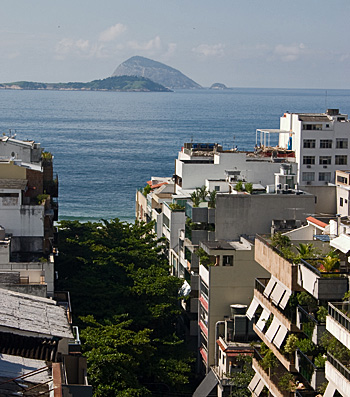
- At Leblon
I know, it’s stronger than you. You’ve read about it in the press. You saw in the movies. Friends have warned you time and again. But tell me something: if Rio were that dangerous, how come there are so many people in the streets all the time? How do you explain the groups of old ladies who go to the theater? Why do so many people still insist on going to the beach? The really dangerous cities are those that will keep you at home, three remotes in hand, for not offering anything fun to be done outside.
The truth is: no crime is bigger than forgetting that the the most interesting city is a 10 or 12-hour tops flight from any major city in the West.
But going to Rio doesn’t have anything to to with justice. It’s all about pleasure.

- Dress in white and live the most unique New Year’s Eve in the world
Go, go, go.
And please don’t shy away of doing all the touristy stuff. Go up the Sugar Loaf and the Corcovado; watch a Flamengo match; go on parade on a samba school – and realize that sometimes clichés can be justified. Follow the latest trend – it may fade in about 15 minutes, but it’s going to be fun. Revisit the classics. Have tea at Confeitaria Colombo, attend a show at Teatro Rival, stalk TV actors at Dias Ferreira restaurant row, have a pork sandwich at Cervantes, start a movement to include Bracarense’s black bean broth at the Unesco cultural treasures list.
And, whenever in doubt, answer “Pela Lagoa” (PAY-luh Lah-GO-uh) no matter what the taxi driver asks.



 , on Amazon.com